Showing posts with label Garden Ornaments. Show all posts

Sunday, July 28, 2013

A Trough Herb Planter

Here's a situation many of us have encountered: shopping with someone and being persuaded to buy something we did not need. While at an antiques show, a friend and I spotted an old Chinese carved granite trough (originally for holding farm animals' drinking water). My friend looked at me, and out came "so cool, Loi!" "You've GOT to buy that!!" Really, but I don't have any horses or pigs??!! After a brief chat, I ended up hauling this massive and heavy-as-heck trough home.

For a while, the trough sat upside down in a hidden corner of the garden :( I thought of converting it into a powder room sink. But, it was just too heavy - both physically and visually.

One morning in the midst of watering all my individual pots of herbs, the idea of using the trough as an herb planter came to me. Yes!!! I now plant it with various herbs, and experiment with different combinations each season. Having most of the herbs in one pot is handy, and easier to water. I also have separate pots for rosemary and mint. The rosemary prefers it drier, while the mint is very aggresive.
 Placed on the sunny terrace outside our kitchen, the herb trough comes in handy.
 Even though our trough already had a hole in the bottom, I placed a layer of gravel to improve drainage.
 I love the scent and taste of thyme! Two varieties here.
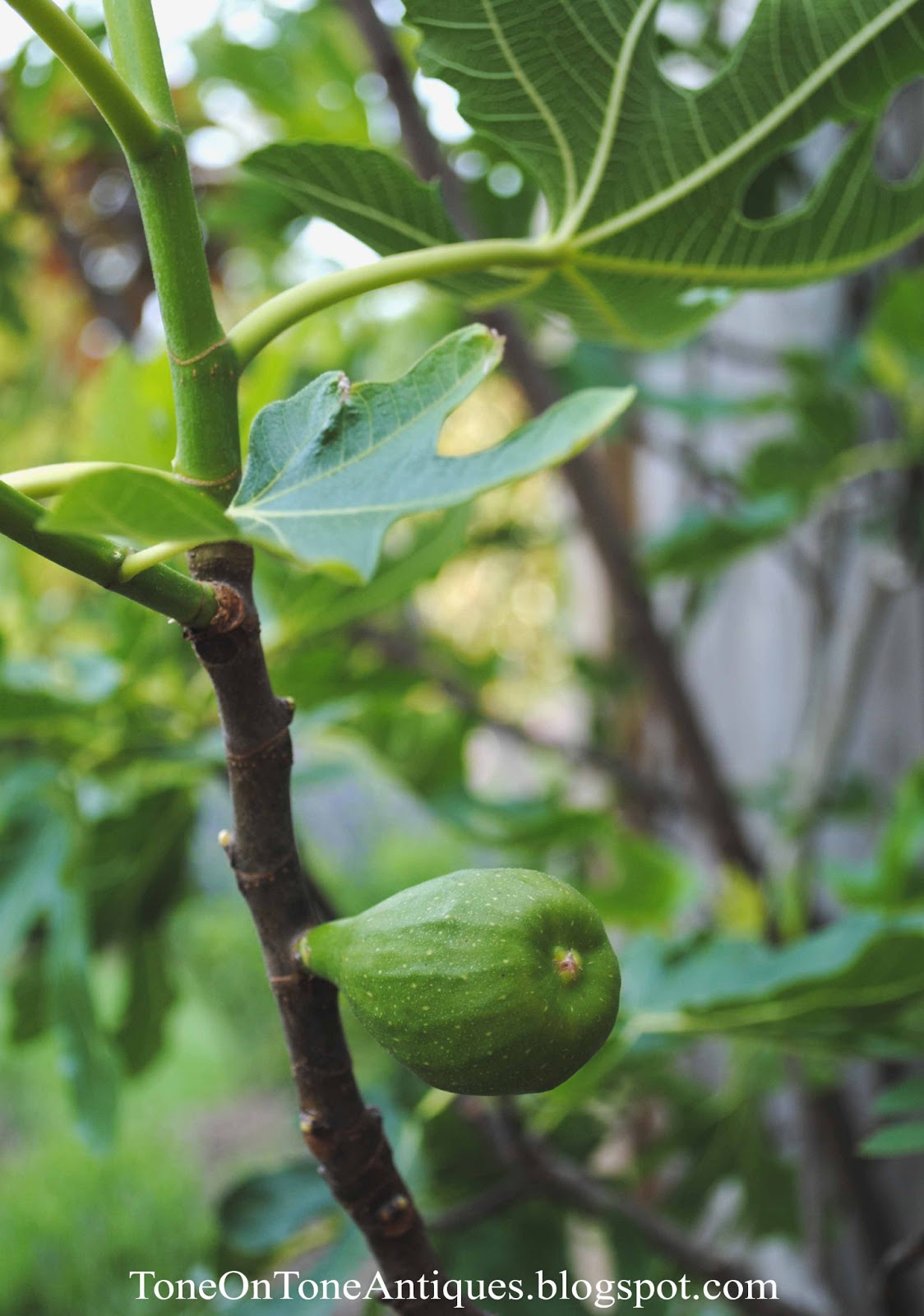
 Together with this prolific fig shrub and pots of rosemary and mint (both not shown), this is our mini urban kitchen garden.
 While we were on vacation, many of the herbs flowered. After these photos, I quickly removed all the flowers. Herbs allowed to flower and seed can die back or develop bitter leaves.
In addition, soapstone sinks, marble wash basins, oversize mortars, and galvanized tubs would make wonderful herb planters. Just make sure to cut / drill a drainage hole. An architectural salvage yard is a great source for such pieces. Also, search online with the following keywords:

- Chinese granite trough
- Stone trough
- Old soapstone sink
- Turkish marble basin

Happy planting! 
Loi

Thursday, May 30, 2013

Tone on Tone Garden Series: Visiting a Blue Garden

It's no surprise that I'm a fan of tone-on-tone color palettes! Whether inside or out, I find using shades of the same color soothing, sophisticated, subtle and harmonious. While there are interiors decorated in this style, it is more challenging to find tone-on-tone gardens - the exception being white gardens which have been popular since the Victorian period. By the way, I have made it a personal goal to visit as many white gardens as possible, so let me know your favorite(s)!

In planning and designing our blue garden, I frequented one of my favorite DC gardens for ideas and inspirations. Located on the grounds of the Washington National Cathedral is the Bishop's Garden. Designed in the early 20th century by landscape architect Frederick Law Olmsted, Jr. and Florence Brown Bratenahl, wife of the second Dean of the Cathedral, this hillside garden is a gem worth exploring.

Inside the high stone wall are herb gardens, perennial borders and beds, a rose garden, a folly (the Shadow House), an expansive lawn, and medieval sculptures and architectural relics. These include a 9th century baptismal font supposedly from the Abbey of St. Julie in the Aisne, 12th century Norman stone arch, 15th century bas-relief plaques, etc.

I recently met with a client at the Bishop's Garden to discuss designs for her blue garden. Enjoy these photos from mid May.
With the majestic cathedral as a backdrop and sounds of church bells ringing, the Bishop's Garden is truly spectacular.
The lower perennial garden beds are known as the blue borders. Next to the blue-gray stone walls, the predominately cool colored flowers create a layered tone-on-tone effect.
A stunning color field of blues, lavenders, purples and whites. Above are Baptisias. Below are Salvias (front left) and Siberian Irises (front right).
A close up of Siberians - so pretty and delicate!
Help! Can you help identify the above? My client and I both want this plant. UPDATE: I just learned that is an Anchusa. Many thanks to Monica and Rosemary!
Located on the south side of a hill, the blue borders get full sun and excellent drainage. Once again, I took these photos in mid May. The borders are equally lovely at the height of summer when Agastaches, Buddleias, Lavenders and Russian Sages are in full bloom.
Here are the beautiful lavender-blue blooms of Nepetas.
I love the royal blue color and feathery foliage of these Larkspurs, which are related to Delphiniums. I cannot grow Delphiniums successfully with our very hot and muggy summers so perhaps I'll give Larkspurs a try. Thank you again to Rosemary for helping me identify these beauties!
Aquilegias and Nepetas spilling over. Notice the repetition in color and plantings, both of which I practice in my designs.
This charming folly is known as the Shadow House. Doesn't the setting remind you of the Cotswolds in England?
Just as important as flowers, foliage in a tone-on-tone garden should be carefully chosen. I find silvery and gray foliage, such as the Lamb's Ears above, complement a blue garden perfectly.
Icy blue flowers and wispy foliage make Amsonias must-haves in the blue garden. Behind is a 15th century carved stone bas-relief of St. Catherine and martyrs.
Punctuating the borders in mid May were many purple Alliums.
Not all the gardens at the National Cathedral are blue themed. In the Hortulus (little garden), the perennials and culinary and medicinal herbs are all inspired by plantings documented in a 9th century monastery. At the center is the French Carolingian baptismal font dating to Charlemagne's time.
Nearby is this 18th century English bronze sundial sitting on a 13th century Gothic capital of carved limestone from a ruined monastery near Reims, France.
I hope you have enjoyed this tour. To read more about the Bishop's Garden, visit here. And if you know of a blue or white garden, please share. Thanks! 
Loi

Tuesday, April 23, 2013

Our Early Spring Garden

It has been a while since I've posted about our garden.With the arrival of warmer weather, much is going on. Bulbs are blooming, trees are leafing out, and perennials are popping up. We've been busy seeding, planting, mulching, fertilizing, pruning, cleaning up, etc. Spring is indeed a very busy time, even in our small city garden.

I like to start each day with a quick survey and walk to see what's changing outside. Here is a look at early spring in our garden.
 Pure sunshine in the small courtyard! While yellow happens to be one of my favorite colors, I seldom use it inside or out. However, I made an exception here with Tete-a-Tete small yellow daffodils. Tete-a-Tetes are early bloomers, and their bright yellow color is a fabulous way to kick off spring. The little fountain finally got its spring cleaning.
 Tete-a-Tetes hold their blooms upright on sturdy stems.
 They bloom early before the Natchez crape myrtles leaf out.
 Next to the front door is this spring blooming camellia with double white flowers. I'm sorry I forgot the name. Anyone know? It is underplanted with white lilies of the valley dug from my friend Charlet's garden.
 So much to do! We planted pansies in the urns, and relaid the pea gravel walkway. The walkway had become dingy, so we replaced the top 50% of the gravel and sand. We recycled the old gravel and sand to beds that needed better drainage.The below photo was taken right after a shower. Everything looks so green! Here the trees are just starting to leaf out.
 The bronze gate handle even got oiled. It now works much better :)
 A few days later, fresh green foliage on the hornbeam trees.
 The birdbath was taken out of storage, and my garden companions have returned. Hi, there, little friend!
 This time of year, the house is still shading most of the white border garden. But look at the profusion of white flowers on the skip laurel hedge. I chose skip laurels for the white border garden because of their white blooms and dark green foliage--a great backdrop for all the white flowers in this garden.
 We planted white periwinkles under the hornbeam trees two years ago. They seem to be taking off. Last year, they suffered from a fungal attack. Fingers crossed!
 Remember the Clematis Paniculata that covered this tuteur last year? I recently gave this vigorous climber a good haircut as it had grown so much. Under the tuteur I've planted another favorite daffodil of mine: Stainless. I love its clean, pure white flowers.